In times of uncertainty, the most secure classroom is the one we build within our homes. The Home-Guard Academic & Safety Protocol (HASP) is a decentralized, parent-led initiative created by TAIEF to ensure that while our children are protected, their intellectual growth, logic, and situational awareness continue to flourish regardless of external circumstances.
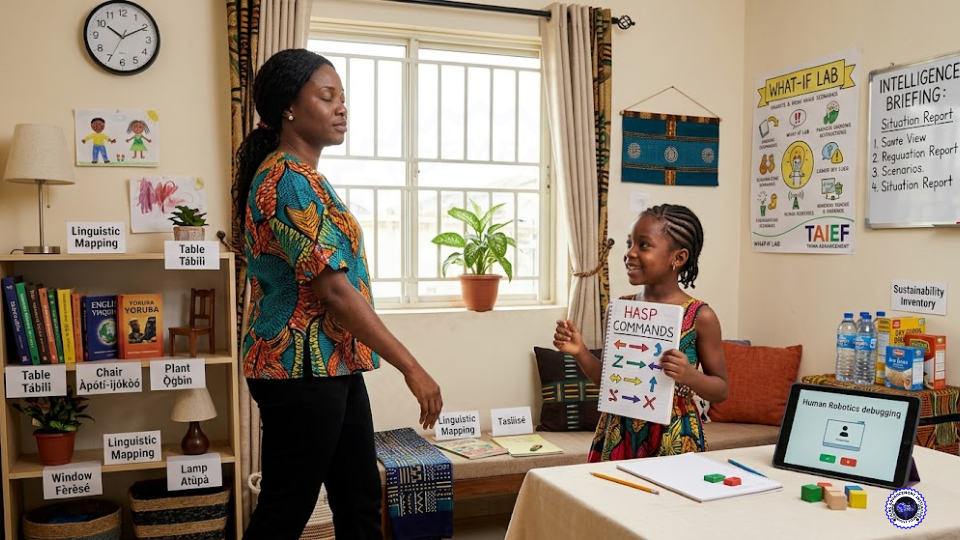
Why HASP Matters: Protecting Potential, Powering Intelligence
The “Smart School” is not a building; it is a mindset. By taking on the role of a “Smart Teacher,” you are ensuring that your child remains sharp, resilient, and prepared for the future.
Here are the five pillars of the HASP framework:
1. The Intelligence Briefing (Speech & Reading)
Observation is the foundation of safety.
- The Activity: Each morning, have your child observe the neighborhood from a safe vantage point.
- The Report: Ask them to write or narrate a “Situation Report” answering: What did they see? What sounds did they hear? Is it calm?.
- The Goal: This builds descriptive language, vocabulary, and keen situational awareness.
2. The Algorithmic Logic (Coding & Math)
Learning to think like a coder does not always require a screen.
- The Activity (Human Robotics): You act as the “User,” and your child is the “Programmer”.
- The Task: The child gives you exact, step-by-step commands to navigate from one room to another. If you hit an obstacle (like a chair), they must “debug” their code and fix their instructions.
- The Goal: Cultivating algorithmic thinking, sequential processing, and high-level problem-solving.
3. The Sustainability Inventory (Math & Critical Thinking)
Understanding real-world resource management is a vital life skill.
- The Activity: Analyze your current household inventory (food, water, power/fuel).
- The Task: Calculate the “Burn Rate”—determine how many days your supplies will last based on current consumption.
- The Goal: Mastering practical math (multiplication/division) while developing strategic foresight.
4. Linguistic Mapping & Cultural Heritage (Coding & Culture)
Preserving our sovereignty begins with language.
- The Activity: Use TAIEF-supported keyboard tools to label household objects in both English and Yoruba.
- The Goal: Enhancing digital literacy, bilingualism, and the preservation of our rich cultural identity.
5. The “What-If” Lab (Critical Thinking)
Moving from reactive panic to strategic action is key to building resilience.
- The Activity: Practice scenarios together. Ask, “If X happens, what are our three safest options?”.
- The Goal: Developing deductive reasoning and an emergency-ready mindset.
Join the Movement
Think Advancement.
