Competing on a global stage is one of the fastest ways for young learners to build confidence, sharpen problem-solving skills, and earn internationally recognized certificates—all without putting financial strain on parents or schools.
Whether your child is just learning block-based coding in primary school or building full-stack web apps and AI projects in secondary school, there are prestigious global competitions with zero registration fees that welcome students from Nigeria and around the world.
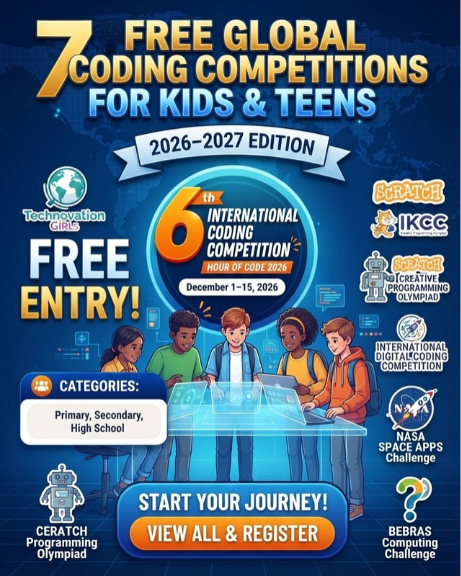
Quick Comparison: Free Global Coding Competitions (2026–2027)
| Competition | Ages / Grades | Languages & Tools | Format & Entry Type | Upcoming / Typical Window |
| Codementum International Coding Competition | Primary, Middle & High School | Block coding, Python, JavaScript (loops, variables, arrays) | Teacher/school-led; 20 challenges in a 120-minute online contest | Dec 1–15, 2026 (6th Edition) |
| Technovation Girls | Ages 8–18 | App Inventor, Thunkable, Python, AI | Teams of 1–5; build a mobile/AI app solving a community problem | Open now until Mar 11, 2027 (submissions due May 5, 2027) |
| IKCC (International Kids Coding Competition) | Ages 7–14 | Scratch | Individual; theme-based online game/project submission | Jan 3–31, 2027 (World Game Coding Competition) |
| International Scratch Creative Programming Olympiad | Ages 7–18+ | Scratch / RobboScratch | Individual; national/consolidated selection stage is free | Annual (2027 season follows) |
| International Digital Coding Competition (IDCC) | Ages 7–17 | Scratch, HTML/CSS/JavaScript | Individual; open-theme game, animation, or web app submission | Annual (Sept–Oct; 2026 winners announced Nov 15) |
| NASA Space Apps Challenge | All ages (Youth & Beginner friendly) | Any language, AI, or no-code/design tools | Teams of up to 6; 48-hour global hackathon using open NASA data | Annual (Oct/Nov) |
| Bebras Computing Challenge | Ages 6–18 | Logic & computational thinking (no coding syntax required) | School-coordinated; 45-minute online problem-solving test | Annual every November |
Detailed Breakdown of Each Competition
1. Codementum International Coding Competition (Hour of Code 2026)
- Official Registration: codementum.com/hour-of-code
- Best For: Primary, middle, and high school classrooms looking for an immediate, structured coding challenge.
- How It Works: Hosted annually in celebration of Computer Science Education Week, the 6th International Coding Competition runs from December 1–15, 2026. Students complete 20 progressive coding challenges using Block coding, Python, or JavaScript, competing across Primary/Elementary, Secondary/Middle School, and High School categories. Teachers register their classes for free to track student progress and compete for global certificates and prizes.
2. Technovation Girls
- Official Registration: my.technovationchallenge.org
- Best For: Young innovators aged 8–18 ready to combine coding, AI, and entrepreneurship.
- How It Works: Working in teams of 1 to 5 alongside a mentor, participants identify a real-world problem in their community—such as education, health, climate, or local commerce—and build a functional mobile app or AI prototype to solve it. Teams also create a pitch video and business plan. Registration is currently open through March 11, 2027, with final project submissions due May 5, 2027.
3. International Kids Coding Competition (IKCC)
- Official Website: ikcc.info
- Best For: Kids aged 7–14 who enjoy creating games and interactive animations in Scratch.
- How It Works: IKCC hosts free international contests multiple times a year. Their next major event, the World Game Coding Competition 2027, opens for registration and project uploads from January 3 to January 31, 2027. A specific theme is revealed on opening day, and children build an original game on MIT Scratch and submit their project link online for evaluation by an international panel of tech educators.
4. International Scratch Creative Programming Olympiad
- Official Website: creativeprogramming.org
- Best For: Young Scratch creators aged 7–18+ seeking an Olympiad-style individual competition.
- How It Works: Drawing over 25,000 participants across more than 70 countries, the Scratch Olympiad challenges students to build creative projects—ranging from interactive books and quizzes to full games and STREAM projects—tailored to their age bracket. Participation in the national/consolidated selection stage is completely free, and Nigerian students have an official pathway through the Consolidated National Stage.
5. International Digital Coding Competition (IDCC)
- Official Website: digital-coding-competition.netlify.app
- Best For: Students aged 7–17 building either Scratch games or responsive websites.
- How It Works: Held annually between September and October, IDCC features two main tracks: a Scratch Division (games, stories, animations) and a Web Development Division (HTML, CSS, and JavaScript hosted on GitHub Pages, Netlify, or Vercel). Because it is 100% open-theme and free to enter, students can submit passion projects they have built throughout the year, and every valid entrant receives an official Certificate of Participation.
6. NASA Space Apps Challenge
- Official Website: spaceappschallenge.org
- Best For: Teens, youth teams, and curious beginners who want to solve real-world Earth and space challenges.
- How It Works: Recognized as the world’s largest annual global hackathon, NASA Space Apps brings together coders, designers, storytellers, and science enthusiasts over one intense 48-hour weekend each October/November. Teams use free, open-source datasets from NASA and international space agency partners (including Nigeria’s NASRDA) to prototype solutions. Students in Nigeria can join local in-person events in cities like Lagos and Abuja or participate globally via the Universal Virtual Track.
7. Bebras Computing Challenge
- Official Website: bebras.org
- Best For: Students aged 6–18 who excel at logic puzzles—even if they have never written a line of code.
- How It Works: Conducted every November through registered schools, the Bebras Challenge introduces computational thinking through a series of fun, interactive 45-minute online logic tasks. Instead of testing programming syntax, it evaluates algorithmic thinking, pattern recognition, and abstraction—making it an ideal entry point for primary and secondary schools introducing computer science.
How Parents, Teachers, and Youth Mentors Can Prepare Students
- Match the Entry Format to Your Setup: If you are a classroom teacher or tech hub coordinator, school-led contests like Codementum (happening December 1–15, 2026) and Bebras allow you to enroll an entire class at once. For motivated individual students or after-school clubs, Technovation and IKCC allow direct project submissions.
- Build a Digital Portfolio Early: Encourage students to save their Scratch links, GitHub repositories, and competition certificates. These documented projects become valuable proof of skill when applying for scholarships, secondary school leadership roles, or international tech fellowships.
- Start with What You Have: Most of these platforms run directly in a standard web browser on a laptop, tablet, or school computer lab using free tools like MIT Scratch and GitHub.
